On Wednesday last week I traveled to the University of Bristol to give a seminar at the Centre for Glaciology. I presented a new physical model for the spectral albedo of ice with algal growth, along with some field data from 2016. Preparing for the talk, discussions with fellow researchers and insightful questions in the … Continue reading Challenges in quantifying ‘bioalbedo’
Category: Cryosphere
Posts relating to ice and snow science
Diverse microbial habitats on the GRIS
We are now well into planning 2017 field work so I revisited some archive footage from previous trips. The short clip below provides a good summary of the great diversity of microbial habitats that exist, even within a very small area of ice. These include cryoconite holes, a cryo-pond (the big cryoconite and water filled pool), algal … Continue reading Diverse microbial habitats on the GRIS
JGR Paper: Predictive model for bioalbedo of snow
Online Early version here. The 'bioalbedo effect' is the accelerated melting of snow and ice due to living organisms growing on it. Life can change the colour of the snow or ice, increasing its efficiency as an absorber of solar energy and causing it to heat up. Our new paper, just accepted by Journal of Geophysical … Continue reading JGR Paper: Predictive model for bioalbedo of snow
Greenland Field Work 2016
Here is a brief field report from our 2016 field season which i also posted on the Arctic Club website (here). 2016 Greenland Field Work Report Our field work aimed to deepen our understanding of the processes darkening the Greenland Ice Sheet. This is important because the colour of the ice sheet is one of the … Continue reading Greenland Field Work 2016
Biocryomorphic evolution on the Greenland Ice Sheet
Our new paper, "Metabolome induced biocryomorphic evolution promotes carbon fixation in Greenlandic cryoconite holes" came out this week. The main finding is that cryoconite holes can change their shape in three dimensions to maintain comfortable conditions for microbial life - an example of biocryomorphology in action. Here's a summary of the main points: Cryoconite holes … Continue reading Biocryomorphic evolution on the Greenland Ice Sheet
An Astronaut’s Guide to Life on Ice?
I recently read the fantastic ‘An Astronaut’s Guide to Life on Earth’ by Canadian astronaut Chris Hadfield. His dedication to realising his childhood dream of going into space is truly inspiring and his account of the many important lessons learned through the entire process, from school to space-station are thought provoking and widely applicable. What … Continue reading An Astronaut’s Guide to Life on Ice?
Cryoconite: Dark Biological Secrets of the Cryosphere
Recently, Tris Irvine-Fynn, Arwyn Edwards, Nozomu Takeuchi and I put together a big review paper detailing the past century and a half of cryoconite research. Here's a brief run-through... What is cryoconite? Cryoconite refers to granules comprising organic and inorganic matter that are formed due to biological activity on ice surfaces. In the paper we … Continue reading Cryoconite: Dark Biological Secrets of the Cryosphere
Biocryomorphology
In a recent publication in Frontiers in Earth Science, Arwyn Edwards, Alun Hubbard and I outlined a framework for developing a more holistic understanding of the cryosphere. We suggest that the complex reciprocal relationships between physical and biological processes on ice surfaces represent a crucial gap in our knowledge of glacial systems, and propose to … Continue reading Biocryomorphology
New Scientist’s “Icy Oases” Article: The full interviews!
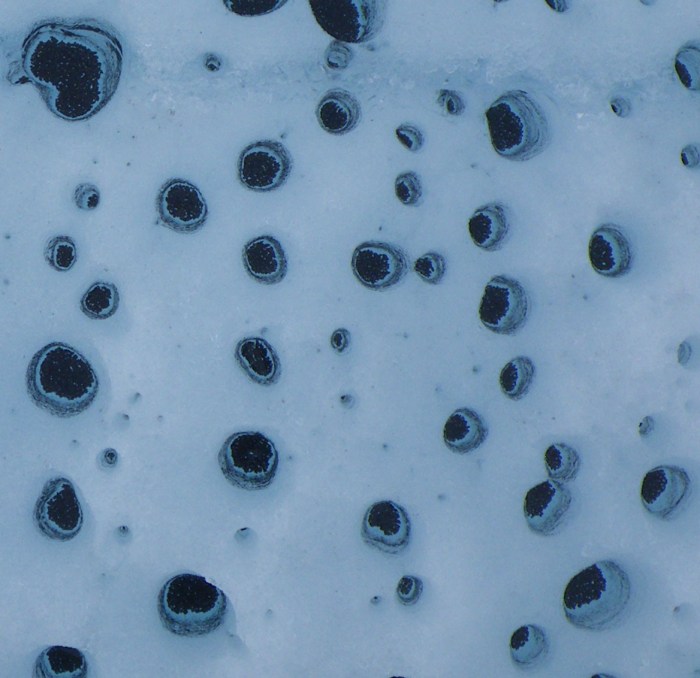
New scientist recently published an article introducing cryoconite holes as oases for microbial life on ice surfaces. As 'new scientists' working on cryoconite, colleagues Arwyn Edwards (Aberystwyth University), Karen Cameron (GEUS / Dark Snow Project) and I were interviewed by science writer Nick Kennedy. Of course only a few sound-bites made it into the final … Continue reading New Scientist’s “Icy Oases” Article: The full interviews!
 To The Poles